A rally is not a race and it is not a convoy. It is twenty or forty cars sharing a public road with everybody else on it, for five days, and almost everything that goes wrong on one comes down to a driver who did not know what the driver near them was about to do. Most of that is fixable with habits that cost nothing.
Everyone is on the radio, and one car is not
On a well-run rally the drivers and their copilots are all on comms: handheld radios, or an app like Voxer running on a phone. A lane change gets called. A slow car ahead gets called. An exit gets called twice. Everybody in the group hears the same thing at the same time, which is what lets a large number of cars move like one.
Then somebody who is not on the rally sees a line of nice cars going the same way they are, and joins in. Not maliciously. It looks like fun, there is a gap, and there is no rule against it.
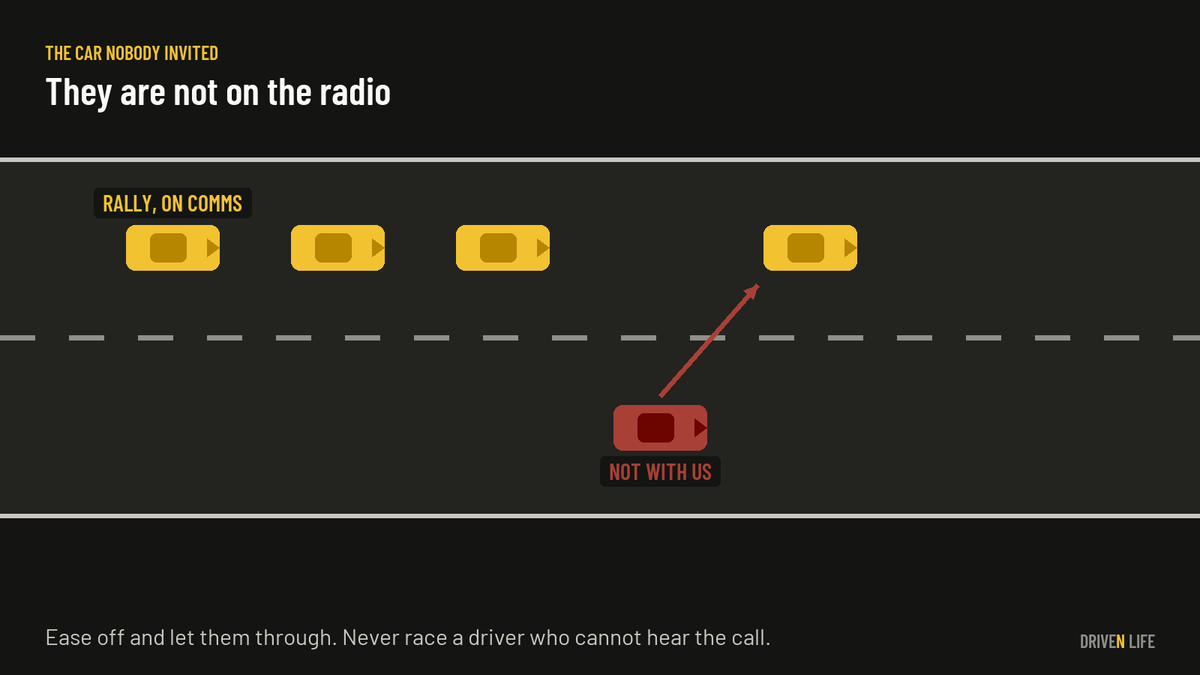
That car is the most dangerous thing on the road for the next few miles, because it is the only one making decisions on its own. It will not know that the front of the group is about to slow for an exit, and it cannot be told. Do not race it, do not box it in, and do not treat it as part of the group. Ease off, leave room, and let it go on ahead.
Signal everything, and answer the signal
Use a turn signal for every single lane change, including the ones that feel obvious. In a group where cars are close together, the signal is often the only warning the car behind gets.
The other half of that habit is the one that makes a group feel calm to drive in. When a rally member ahead signals into your lane, flash your high beams once. It means: seen you, come across.
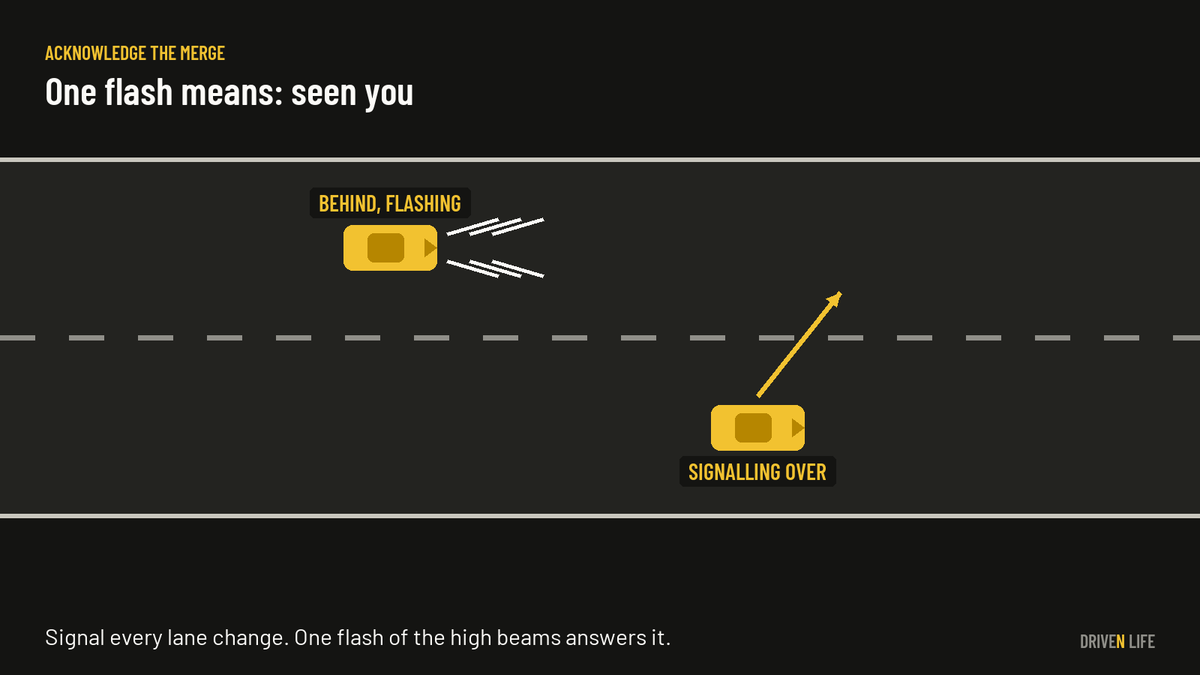
Without it the driver merging is guessing, and a guess at speed with a car alongside is how paint gets traded. It takes half a second and it removes all of the doubt.
If somebody has to pull off
Something will happen. A warning light, a tire, a phone that has to be answered. The instinct when a friend pulls onto the shoulder is for everybody to pull over with them, and that instinct is wrong.
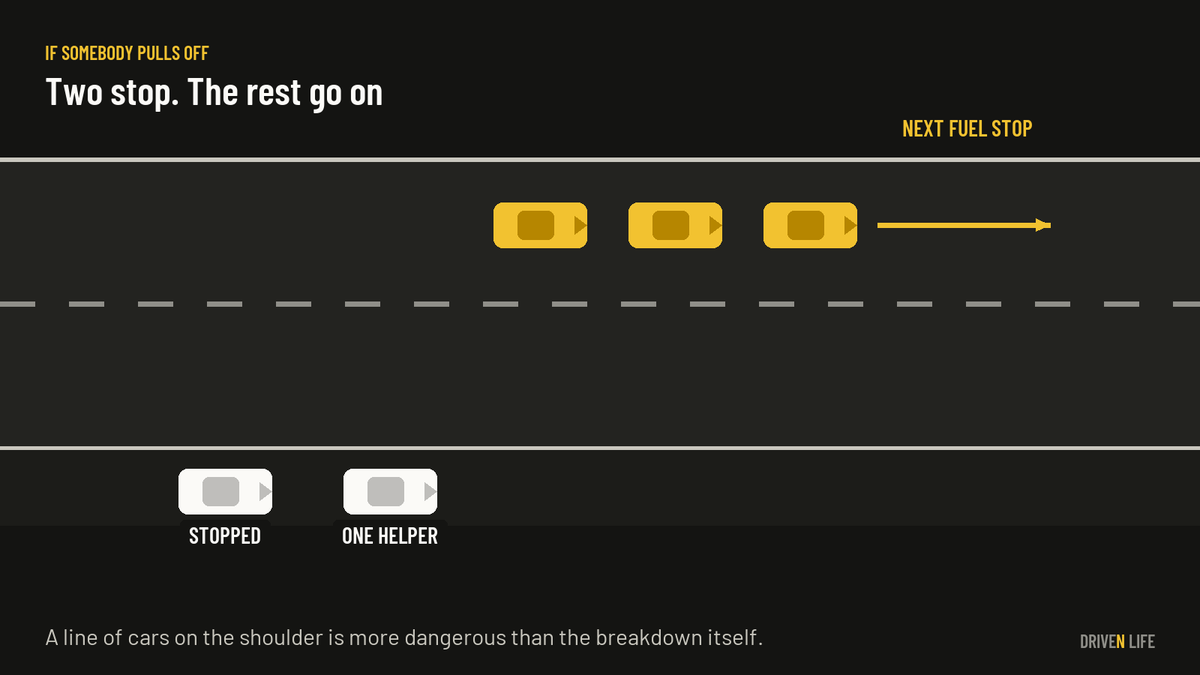
One or two cars stop to assist. That is enough for any problem that can be solved on a shoulder, and more than enough to make the stopped car visible. Everybody else carries on to the nearest gas station and regroups there, off the road, where there is light and space and a bathroom.
From there it is a decision rather than an emergency: wait for the others to catch up, or press on to the next stop and meet them at the hotel. Both are fine. A row of cars parked on a highway shoulder is not.
Speed in bursts, not in stretches
Nobody buys a car like this to sit at the limit for five days, and pretending otherwise is dishonest. The rule that matters is about duration rather than numbers. If the speed goes up, bring it straight back down. A short burst is a moment. Holding it for twenty minutes turns a group of cars into a spectacle, attracts exactly the attention nobody wants, and leaves the slower cars in the group with a choice between falling behind and driving beyond what they are comfortable with.
Stay with the group
The pack drifting apart is the quiet failure mode of a long drive. It starts with one car pushing on, then a gap, then a second group, and by the next fuel stop half the rally is somewhere on a hundred miles of interstate on its own.
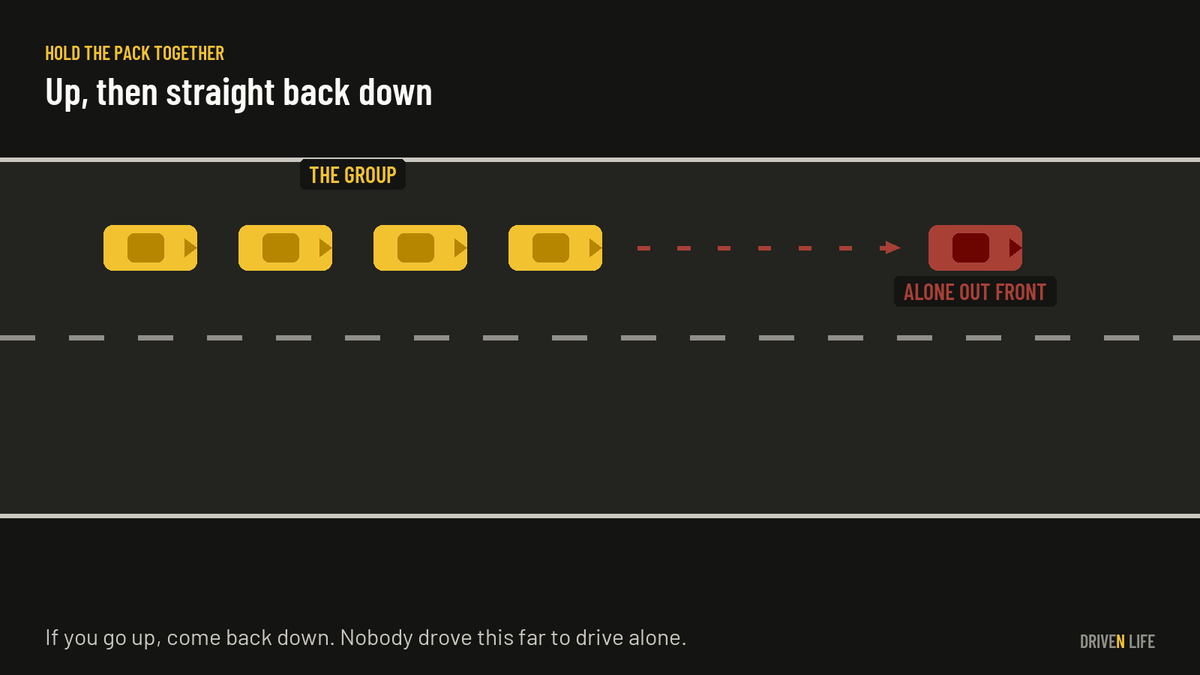
Nobody drove this far to drive alone. If the car ahead is out of sight, the group has already broken; call it on the radio and let people close up. Sticking together is not only more fun. It is the thing that makes every rule above work, because a group that can see each other can look after each other.
The short version
Before the next one
Get on the comms channel before you roll out. Signal every lane change. Flash once to answer a merge. Let the uninvited car go. Two cars stop, everyone else regroups at the next fuel stop. Speed in bursts, never in stretches. And keep the car ahead of you in sight.