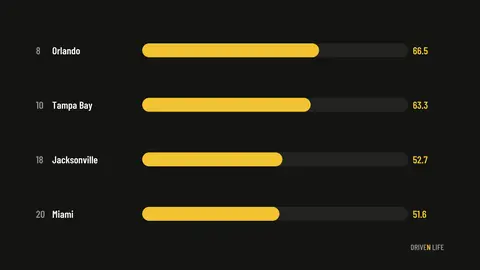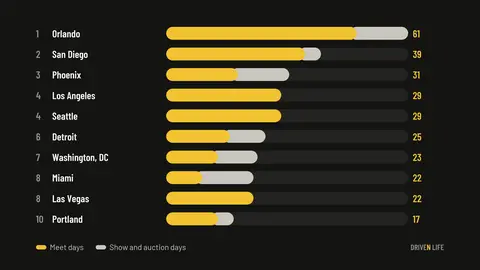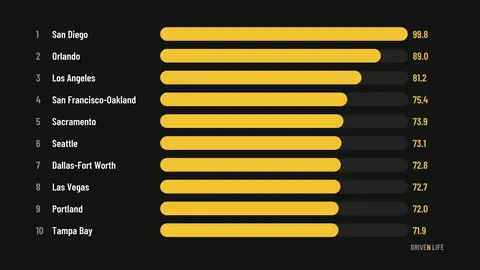
The Car Scene Index 2027 ranks the 50 largest metro areas in the United States on what a car person can do there and check in advance: the recurring meets you can drive to, the big annual events, the tracks and drag strips that let you drive your own car, the car museums with public hours, and how many months of the year a weekly meet runs. Each of the 485 counted records was read at its source on 15 and 16 November 2026, usually the organizer’s own page or social account, otherwise the venue’s page or, where the rules below allow it, a dated local news report. Every record is kept with its source and the date it was read, and the whole dataset is published as a spreadsheet.
It measures what organizers publish and a newcomer can confirm. It does not measure car culture at large: crowds, quality, the meets that live on group chats and phone lists, or anything outside the 50 largest metros.
The short version
- Which cities: the 50 largest metro areas by the Census Bureau’s Vintage 2025 estimates, each as the Census draws it (Los Angeles means Los Angeles and Orange counties; Miami means Miami-Dade, Broward and Palm Beach).
- What counts: a meet, event, venue or museum is counted only when its own page, its organizer’s own social account, the venue’s page or a dated local news report (for a meet’s day and place, or an event’s 2026 dates) says it exists and when it runs. A directory listing or another site’s list is never enough.
- The same search everywhere: every metro got the same meet searches, the same meet directory (GetOutGarage’s recurring listings within 100 km), the same event searches, museum search and venue frame. Meets and events that only Driven Life’s own earlier pages had turned up are left out (35 meets and 7 events), because Driven Life had covered some metros far more than others.
- How complete it is: the meets Driven Life had already verified are used to measure the search, and count only when the same search also finds them. Across 31 metros the search finds a median 90% of them on its own (lowest 33%); 19 metros have no known meets to test against. Every metro is listed below.
- The score: eight measures, with weights written down on 15 November 2026 before any metro was counted and unchanged since. The headline scores with the rules as they stood then. Four rules changed during the count, and on review the meet search was widened the same way in every metro; the results under each version are shown below.
- How sure is the order? No metro is first in two-thirds of 10,000 random reweightings (Los Angeles 63%, San Diego 32%), and six metros stay in the top 10 in at least 90% of them.
- Who did the work: The research, counting and drafting were done by AI (Anthropic’s Claude) from organizer and public sources, checked by software against the written rules, and approved for publication by the publisher on 16 November 2026.
Which cities are in it
The 50 largest metropolitan statistical areas in the Census Bureau’s Vintage 2025 population estimates, released 26 March 2026. A metro is the Census Bureau’s own line around a group of counties, so a meet counts for a metro when its venue sits in one of those counties. Los Angeles is Los Angeles and Orange counties together; Riverside-San Bernardino is its own metro; San Francisco-Oakland and San Jose are two. Dallas-Fort Worth is one metro, and so is Minneapolis-St. Paul.
That choice leaves out places with a big scene for their size: Naples, Sarasota, Daytona Beach, Tucson, Monterey, Carlisle. They are not in the 50 largest metros, and a ranking that picked them in by hand would be choosing its answer. They have their own pages on Driven Life, linked from the events calendar.
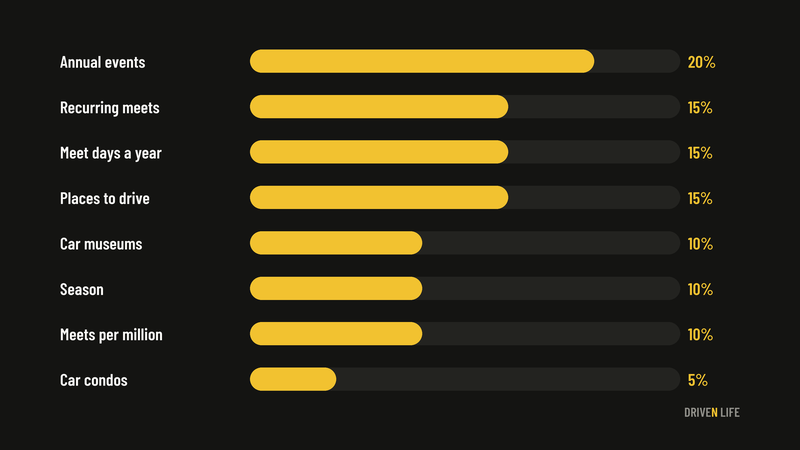
The eight measures and their weights
- Recurring meets counted (weekly, every two weeks, twice monthly or monthly), verified on the organizer’s own channel with 2026 evidence: 15%.
- Meet days a year: weekly 52, every two weeks 26, twice monthly 24, monthly 12, each scaled by the months the meet runs: 15%.
- Annual marquee events (concours, collector-car auctions, auto shows, national-series shows, festivals over the size bar) with 2026 or 2027 dates published by the organizer, the venue or the auction house: 20%.
- Places within 60 straight-line miles of the principal city where you can drive your own car: venues with track days, test-and-tune or autocross, plus club autocross sites, each on a 2026 or 2027 calendar: 15%.
- Car museums in the metro with public opening hours on their own site: 10%.
- Months a year with at least one weekly meet running, by the organizer’s stated schedule: 10%.
- Recurring meets per million residents (Census Vintage 2025): 10%.
- Open car condo and garage club facilities in Driven Life’s directory: 5%.
Counts are scaled on a log curve before they are compared (0 for the lowest metro, 100 for the highest), so that the biggest metros do not win every measure on size alone: going from 2 meets to 10 moves a city further than going from 40 to 48. Season is scaled straight, 12 months being 100. Meets per million residents is rounded to two decimals before it is scaled, as the code fixed before the count does; that moves no metro by more than a tenth of a point. Two metros whose scores round to the same tenth share a rank.
The weights were committed to the index’s own files at 21:58 on 15 November 2026, before any metro’s data came back, and they have not changed since.
What counts as a meet
A public car gathering that repeats at least once a month at a fixed place: cars and coffee, cruise-ins and cruise nights, and meets for exotics, imports or trucks that keep a regular schedule. Swap meets, track nights, club-only meetings, rallies, one-off shows and street takeovers do not count.
A meet is counted only when three things hold, the same three every meet page on Driven Life has to pass. Its day and place were read on the organizer’s own website or social account, the venue’s own page, or a dated local news report. There is dated evidence from 2026 that it still runs. And its schedule is stated by the organizer or venue (“every Saturday”, “the first Sunday of the month”), not guessed from a few past dates. Instagram shows a reader no post dates; where a date was needed, it was read from the timestamp encoded in the organizer’s own post ID.
Meets that failed were not dropped silently. The dataset lists 1,608 held-back meet records, each with its reason: only a directory listing, an organizer silent since 2024, no stated schedule, a rotating venue, closed, outside the metro, or found only through Driven Life’s own pages.
One search in every metro
Every metro got the same four web searches for meets: cars and coffee in the principal city; a weekly car meet in that city in 2026; a cruise night in that city in 2026; and cars and coffee in the second city the Census names in the metro’s title (or, where it names one, the largest other county). To those were added up to two roundup pages from the results and one events directory’s listing for the state, used only to find names. No metro reached the cap of 50, so every candidate the fixed searches surfaced was checked.
Then, on review, every metro got the same directory read: every recurring meet that GetOutGarage, a national car events directory, lists within 100 km of the principal city with a weekly or monthly schedule, and every counted car museum’s own events page. That added 719 candidates the searches had not turned up. A directory listing is never evidence: each candidate was checked on its organizer’s or venue’s own channel under the same three tests. The organizer’s channel was looked for the same way in every metro, at a link the listing gives or at a handle or web address made from the listed name, venue or named host, with no web search. 13 of the new candidates passed, and so did 6 candidates the searches had found but held for want of an organizer link, once the same lookup found one.
Driven Life’s own earlier meet pages and held-back lists were checked as well, but a meet found only there does not count. Driven Life had covered some metros far more than others: five of the meets San Francisco-Oakland would otherwise have counted came only from its pages, and two of Dallas-Fort Worth’s nine. Counting them would have ranked a city higher because Driven Life had written about it. In all, 35 meets that passed every other check are left out for this reason; they keep their guides on the site. With them put back, the top 10 would be Los Angeles, San Diego, San Francisco-Oakland, Dallas-Fort Worth, Las Vegas, Detroit, Tampa Bay, Orlando, Phoenix and Seattle.
A second check goes further. Of the 181 counted meets, 86 were found by the fixed searches or the directory, but their organizer’s page was first reached through a link on a Driven Life guide, and a metro without that guide might have held them for want of a link. So each was put through the same lookup every new candidate got, run from its listing: for 43 of them it reaches the same organizer channel, and for 43 it does not. Dropping those 43 as well, an upper bound on the tilt, changes the 10: Washington DC in, Dallas-Fort Worth out, and Los Angeles would be first in 69% of reweightings. The tiers come from the headline method alone. One rule, applied to every metro, carries this check into the rankings: a metro whose rank falls by more than three places under it is flagged, in its entry and in the full list, with its rank under the check. Nine metros are flagged: Dallas-Fort Worth, third (12th under the check); New York, 12th (21st under the check); Houston, 15th (21st under the check); Baltimore, 17th (37th under the check); Jacksonville, 18th (27th under the check); Riverside-San Bernardino, 23rd (43rd under the check); Charlotte, 27th (34th under the check); Nashville, 32nd (36th under the check); San Antonio, 35th (46th under the check).
How complete is the count?
Driven Life had already verified some meets on its own pages before this census: 117 of them in 31 metros. Being known to Driven Life never makes a meet count. They were used in two ways. They measure how much the fixed search misses: for each metro, recall is the share of them the uniform search finds on its own. And they decided which directory listings brought a meet back into the count: 41 counted meets are ones Driven Life had verified whose directory listing was matched to them by hand, and they count with the verification they already had rather than through the fresh lookup new candidates got. No weight or rule was set from them. With the four web searches and the state listing alone, the median metro’s recall was 50% and the lowest 0%: a city’s place depended partly on how findable its meets are by web search. With GetOutGarage’s listings and the museums’ event pages added in every metro, the median is 90%, the lowest 33%, and 78% of all the known meets are found.
Recall is untested in the 19 metros where Driven Life had verified no meets: Detroit, Cincinnati, Pittsburgh, Minneapolis-St. Paul, Providence, Birmingham, Grand Rapids, Oklahoma City, Milwaukee, Indianapolis, Columbus, Cleveland, Boston, St. Louis, Louisville, Hartford, Fresno, San Jose and Memphis. That includes Detroit (fourth) and all seven metros where no meet counted; for them nothing here measures how complete the count is. Where recall is measured it likely flatters the count, because meets Driven Life had already found are easier to find than ones nobody has listed.
Recall stays below 60% in San Francisco-Oakland, Tampa Bay and Raleigh. Their missing meets are not in the directory and the web searches did not surface them, and adding a source that only helps those metros would bring back the tilt this rule removes. Read their places with that in mind; a meet that is missing can be sent in (address below).
- Baltimore: 2 of 2 (100%; version 2 found 1).
- Charlotte: 1 of 1 (100%; version 2 found 1).
- Chicago: 1 of 1 (100%; version 2 found 1).
- Denver: 1 of 1 (100%; version 2 found 1).
- Houston: 5 of 5 (100%; version 2 found 3).
- Jacksonville: 3 of 3 (100%; version 2 found 2).
- Kansas City: 1 of 1 (100%; version 2 found 0).
- Los Angeles: 5 of 5 (100%; version 2 found 1).
- New York: 2 of 2 (100%; version 2 found 1).
- Portland: 1 of 1 (100%; version 2 found 1).
- Richmond: 2 of 2 (100%; version 2 found 2).
- Sacramento: 3 of 3 (100%; version 2 found 2).
- Salt Lake City: 1 of 1 (100%; version 2 found 1).
- San Diego: 4 of 4 (100%; version 2 found 4).
- Virginia Beach-Norfolk: 2 of 2 (100%; version 2 found 2).
- Orlando: 9 of 10 (90%; version 2 found 5).
- Dallas-Fort Worth: 7 of 8 (88%; version 2 found 1).
- Austin: 5 of 6 (83%; version 2 found 5).
- Las Vegas: 3 of 4 (75%; version 2 found 2).
- Miami: 3 of 4 (75%; version 2 found 2).
- Nashville: 3 of 4 (75%; version 2 found 3).
- Seattle: 3 of 4 (75%; version 2 found 3).
- Philadelphia: 2 of 3 (67%; version 2 found 0).
- Phoenix: 2 of 3 (67%; version 2 found 0).
- Riverside-San Bernardino: 4 of 6 (67%; version 2 found 3).
- San Antonio: 2 of 3 (67%; version 2 found 2).
- Washington DC: 4 of 6 (67%; version 2 found 2).
- Atlanta: 3 of 5 (60%; version 2 found 1).
- San Francisco-Oakland: 4 of 9 (44%; version 2 found 0).
- Tampa Bay: 2 of 5 (40%; version 2 found 0).
- Raleigh: 1 of 3 (33%; version 2 found 0).
Annual events
An annual event counts when it is held in the metro, runs every year, has its dates published, and is one of: a concours d’elegance, an in-person collector-car auction, a public auto show, a stop of a national show series, or another car show or festival that runs more than one day, sells spectator tickets or states a size of 500 cars or more. The dates must be the 2027 edition’s, or the 2026 edition’s when 2027 is not out yet, published by the organizer, the venue or the auction house (a dated 2026 news report counts for a 2026 edition’s dates). “Runs every year” means the organizer calls it annual or numbers its editions, or it ran in both 2025 and 2026; “returns” or “again” is not enough, and neither is a news report’s adjective. An event missing from its organizer’s published 2027 schedule is not counted.
Pro race weekends (Formula 1, IndyCar, NASCAR, IMSA) are left out on purpose: they measure where a series sells tickets, not what local car people do. One-day free shows that state no size are left out too, which is the bar that keeps hundreds of good local shows out of this count; the bar has to sit somewhere, and it sits where it can be checked.
Each metro got three searches for its 2026 and 2027 shows, plus one per state for its concours, and the 2026 and 2027 calendars of the national auction houses and show series were read in full and sorted by metro. Of the 127 counted events, 75 had 2027 dates published when they were read. Seven events found only through Driven Life’s own event pages are left out, among them the Grand National Roadster Show in Pomona; counting it would move Los Angeles from 79.2 to 80.5 and leave it first. The Woodward Dream Cruise, which its organizer says draws 40,000 classic cars, would pass on size, but Detroit’s fixed event searches did not surface it and no event is added by hand; counting it would move Detroit from 71.0 to 72.6 and up to third.
Places to drive your own car
A venue counts for a metro when it sits within 60 straight-line miles of the principal city and its own site, or its organizer’s own calendar, shows a 2026 or 2027 date for something an ordinary enthusiast can enter with a street car: a track day or open lapping day, a test-and-tune or street-car night at a drag strip, or an autocross. Club autocross programs count by site, even when the site is a stadium lot or a fairground. Karting-only tracks, private clubs with no day access, and venues whose only public offer is a grandstand ticket do not count.
The measure counts places, so several clubs’ autocross programs on one lot, or two records for one complex, are one place: 178 venue records make 160 places, and 134 of them sit within 60 miles of at least one principal city. Because the test is distance, one place can count for two metros: a track between two cities is open to drivers from both.
Museums, season and car condos
A museum counts when its main collection is cars (or cars and motorcycles, or a racing hall of fame with cars on the floor), it sits in the metro, and its own site publishes regular opening days and hours. A collection whose own site says visits are by appointment is held back, and so is one found outside the museum search. Of the museums the searches turned up, 43 passed and 114 were held, among them the North Texas Automotive Museum (its site says “open to visitors by appointment”), the Beller Museum (tours arranged by phone) and the Blackhawk Museum (one gallery of six is automotive).
Season is the number of months a year in which at least one counted weekly meet runs, by its organizer’s stated schedule; a weekly meet that states no season counts all twelve months. That is the rule fixed before the count, and the headline uses it. It has two weaknesses, which is why it was changed during the count and why the change is shown below: it gives a metro whose meets are all monthly no season at all (Phoenix and Austin among them), and because organizers rarely post their winter breaks it can overstate winter in cold metros. The list of best winter car scenes uses the stricter standard: winter must be shown.
Car condos and garage clubs come from Driven Life’s own directory of car condos, checked facility by facility on 13 November 2026. Only open facilities count. It carries the lowest weight, 5%, because a car condo is a sign of collectors with money rather than a place most readers will go.
How sure is the order?
The weights are a judgment, so the index was recomputed 10,000 times with weights drawn at random around the published ones (a fixed random seed, so anyone can repeat it). Los Angeles came first in 63% of those runs, San Diego in 32%, Phoenix in 3%, Dallas-Fort Worth in 2%. Six metros stayed in the top 10 in at least 90% of runs (Los Angeles, San Diego, Dallas-Fort Worth, Detroit, San Francisco-Oakland and Seattle); Las Vegas (87%), Phoenix (74%), Orlando (78%) and Tampa Bay (60%) held a place in 50% to 90%, and Washington DC (50%), New York (22%) and Austin (18%) in 10% to 50%. No metro is first in two-thirds of runs, so the pages present tiers rather than a single first place.
Taking out one measure at a time changes the 10 in four of the eight cases: without annual events, Washington DC comes in for Phoenix; without museums, Washington DC comes in for Las Vegas; without season, Austin comes in for Tampa Bay; without meets per million residents, New York and Washington DC come in for Orlando and Tampa Bay.
Other checks: giving every measure the same weight leaves the 10 unchanged; ranking each measure instead of scaling it leaves the 10 unchanged.
How the method changed during the count
The protocol, the weights and the code that turns records into a ranking were committed at 21:58 Eastern on 15 November 2026, before any metro’s data came back. The weights have not changed. Four rules changed while the count was under way, and four decisions were made on review before publication. Each is listed with when it entered the index’s history, and with what the headline uses now.
- 15 November, 23:23, with 3 of 50 metros’ meets counted: finding an organizer. One web search per candidate became links followed from the listings and results already in hand, because the search budget could not carry 50 metros; a search was kept for candidates named by two or more sources. The metros counted before were re-checked. The headline keeps this; it changed how organizers were reached, not what counts.
- 15 November, 23:23: the candidate cap. It began at 30 a metro and was raised to 50 after Los Angeles and San Diego reached it. The headline keeps 50, because the old cap cannot be applied exactly now: the protocol’s order for which candidates to check first does not place candidates found only on a roundup page, and San Diego’s two candidates over 30 by that order may be two of its counted meets. At worst San Diego still ranks second.
- 15 November, 23:23: venues. Records within half a mile became one place. The code fixed before the count counted one place per record while the measure fixed beside it counts places; both could not be applied, and the headline follows the measure. The per-record version is shown below.
- 16 November, 05:15, after 35 metros’ events: events. Driven Life’s own event pages became event candidates, the auction and show-series calendars were re-read in full, and each state’s concours search was applied to every metro reaching into that state. The headline keeps the re-read and the state searches, which every metro got, and leaves out the 7 events found only through Driven Life’s pages.
- 16 November, 07:03, after 41 of 50 metros’ meets were counted: season. Season was changed to count months with any counted meet, winter only when shown. At 01:26 that morning the index’s own notes had recorded the opposite decision, to keep the rule as fixed, and interim rankings could be computed from the data then in hand. Because the change came mid-count and moved results, the headline uses the rule as fixed before the count. Under the changed rule Los Angeles would be first in 42% of reweightings, and the top 10 would be Los Angeles, Phoenix, San Diego, Dallas-Fort Worth, Detroit, Las Vegas, Austin, Orlando, San Francisco-Oakland and Seattle.
- On review, 16 November: a deeper search for every metro. Measured against the meets Driven Life had already verified, the four searches found a median 50% of them, and as few as 0% in some metros. Every metro then got the same directory read (GetOutGarage’s recurring listings within 100 km, and counted museums’ event pages) and the same organizer lookup for every candidate that lacked a link. The version 2 result is shown below beside the headline.
- On review, 16 November: three decisions. Records found only through Driven Life’s own pages were taken out of every measure. Every rule was re-applied to every record, with the open questions settled on the organizer’s own page that day (18 records held as a result, among them events missing from their organizer’s 2027 schedule and museums open by appointment). And the season rule went back to the version fixed before the count.
The results under each version of the rules
- The meet search as it stood before review (the four web searches, roundup pages and state listing only, with no directory read): San Diego, Los Angeles, Detroit, Las Vegas, Seattle, Phoenix, Orlando, New York, Washington DC and Portland; New York, Portland and Washington DC in, Dallas-Fort Worth, San Francisco-Oakland and Tampa Bay out; first: San Diego (70% of reweightings).
- Season as amended on 16 November (any counted meet; no stated season counts March to November unless winter is shown): Los Angeles, Phoenix, San Diego, Dallas-Fort Worth, Detroit, Las Vegas, Austin, Orlando, San Francisco-Oakland and Seattle; Austin in, Tampa Bay out; first: Los Angeles (42% of reweightings).
- Venues counted one per record, as the pre-registered code did (several clubs at one lot count several times): Los Angeles, San Diego, Detroit, Dallas-Fort Worth, San Francisco-Oakland, Phoenix, Las Vegas, Orlando, Seattle and Tampa Bay; the same 10; first: Los Angeles (65% of reweightings).
- The pre-registered cap of 30 candidates, at its worst for San Diego (La Jolla Cars and Coffee not checked): Los Angeles, San Diego, Dallas-Fort Worth, Detroit, San Francisco-Oakland, Las Vegas, Phoenix, Orlando, Seattle and Tampa Bay; the same 10; first: Los Angeles (66% of reweightings).
- Also removing counted meets whose organizer channel was reached through a Driven Life page’s link and that the uniform version 3 lookup does not reach from their listing: Los Angeles, San Diego, Detroit, San Francisco-Oakland, Las Vegas, Seattle, Phoenix, Tampa Bay, Washington DC and Orlando; Washington DC in, Dallas-Fort Worth out; first: Los Angeles (69% of reweightings).
- With the records found only through Driven Life’s own pages put back (the check run the other way): Los Angeles, San Diego, San Francisco-Oakland, Dallas-Fort Worth, Las Vegas, Detroit, Tampa Bay, Orlando, Phoenix and Seattle; the same 10; first: Los Angeles (74% of reweightings).
What this cannot see
- Size. A meet that draws 2,000 cars counts the same as one that draws 40. Organizers rarely publish a number and nobody audits the ones they do, so the index counts meets, meet days and months instead.
- Cruise nights run through phone numbers, club newsletters and regional calendars. They cannot pass the source rule, and the older cruise-night culture of the Northeast and Midwest leans on them more than the Sunbelt’s Instagram meets do. Hartford’s candidates, nearly all cruise nights on a regional calendar with no organizer page behind them, are the clearest case. A metro with no counted meet is a metro whose meets do not publish in a way this rule can check, not a metro with no scene.
- Scenes that live on Instagram stories and group chats. A meet with no public schedule cannot pass the source rule either, and the count misses all of them.
- Quality, crowds and rules. Whether a meet is welcoming, well run or one bad exit away from losing its lot is not in the numbers. The meet pages on Driven Life carry each organizer’s own rules.
- Everything outside the 50 largest metros, by design.
- Counts are floors, not censuses. A fixed search finds the meets a newcomer would find. A local with ten years in the scene knows more. The fixed search is what makes the cities comparable.
The data
The full dataset is one spreadsheet: car-scene-index-2027-data.csv. It has every counted record, one row per metro it counts for, with its source and the date it was read, and every candidate held back, with the reason. The rulings on individual records and the history of every rule change are kept with the index’s code, and any organizer or reporter who wants them can write to the address below.
How it was made
The census ran on 15 and 16 November 2026, metro by metro, to a written protocol that records every query run, every candidate checked and every source read, with the date. The research, counting and drafting were done by AI (Anthropic’s Claude) from organizer and public sources, checked by software against the written rules, and approved for publication by the publisher on 16 November 2026. What keeps that honest is the paper trail: every counted record rests on a source a reader can open, the weights were fixed in writing before the counting began, and every rule that changed during it is listed above with its date and its effect.
Driven Life is a car culture publication. No city, organizer, venue or museum paid to be counted or to rank where it does, and nothing in this index can be bought. Featured placements in Driven Life’s car condo directory, if they are ever sold, never change which facilities are counted. The Editorial Standards page sets out how facts are checked and corrected.
Is your meet missing?
Write to keys@drivenlife.co with the meet’s name, its day and time, the venue, and a link to the organizer’s own page or account where the schedule is posted. Driven Life checks it against that page, and a meet that passes gets its own guide on Driven Life and counts in the next edition. Organizers can use the same address to correct anything on these pages.
Questions
Why these 50 cities and not my town? The index covers the 50 largest metro areas because a fixed universe is the only way to compare fairly. A smaller city with a great scene is not ranked, by design, rather than by oversight.
My city has dozens of meets. Why does it show only a few? Because a meet counts only when its organizer publishes when it runs, there is dated proof it ran in 2026, and the same searches and directory read that every metro got turned it up. Of 1,608 meet candidates held back, most failed on the first two: a directory listing with no organizer behind it, or an account with no dated post. If your meet publishes its schedule, write in and it will count next year.
Can a city pay to rank higher? No. Nothing in the index can be bought, and no city, organizer, venue or museum paid to be counted.
Who made it? The research, counting and drafting were done by AI (Anthropic’s Claude) from organizer and public sources, checked by software against the written rules. The publisher approved the pages for publication on 16 November 2026; the dataset is published so anyone can check them.
Will it be updated? Yes, once a year, with the same protocol, so the editions can be compared. Corrections to a counted record are made as soon as they are checked, and logged on the corrections page.
What was read, metro by metro
The record of the census, in the same order for every metro: the meet candidates checked and counted, the event candidates checked and counted, and the places to drive within 60 miles, with the date each metro was read. Every metro got the same four meet searches, the same directory read and three event searches.
- Atlanta: meets 58 checked (18 of them from the directory read), 6 counted, 3 more found only on Driven Life (read 16 Nov); events 14 checked, 2 counted (read 16 Nov); places to drive 3.
- Austin: meets 27 checked (6 of them from the directory read), 8 counted, 1 more found only on Driven Life (read 16 Nov); events 13 checked, 3 counted (read 16 Nov); places to drive 2.
- Baltimore: meets 47 checked (22 of them from the directory read), 3 counted (read 16 Nov); events 11 checked, 1 counted (read 15 Nov); places to drive 5.
- Birmingham: meets 21 checked (6 of them from the directory read), 5 counted (read 16 Nov); events 2 checked, 1 counted (read 16 Nov); places to drive 3.
- Boston: meets 29 checked (21 of them from the directory read), 0 counted (read 16 Nov); events 5 checked, 3 counted (read 15 Nov); places to drive 3.
- Charlotte: meets 51 checked (18 of them from the directory read), 1 counted, 2 more found only on Driven Life (read 16 Nov); events 12 checked, 5 counted (read 15 Nov); places to drive 3.
- Chicago: meets 69 checked (57 of them from the directory read), 3 counted (read 16 Nov); events 8 checked, 2 counted (read 16 Nov); places to drive 2.
- Cincinnati: meets 22 checked (6 of them from the directory read), 3 counted (read 16 Nov); events 6 checked, 4 counted (read 16 Nov); places to drive 1.
- Cleveland: meets 20 checked (10 of them from the directory read), 0 counted (read 16 Nov); events 5 checked, 3 counted (read 16 Nov); places to drive 5.
- Columbus: meets 20 checked (6 of them from the directory read), 2 counted (read 16 Nov); events 4 checked, 1 counted (read 16 Nov); places to drive 3.
- Dallas-Fort Worth: meets 55 checked (27 of them from the directory read), 7 counted, 2 more found only on Driven Life (read 16 Nov); events 11 checked, 4 counted (read 16 Nov); places to drive 6.
- Denver: meets 39 checked (8 of them from the directory read), 2 counted (read 16 Nov); events 7 checked, 3 counted (read 16 Nov); places to drive 3.
- Detroit: meets 62 checked (32 of them from the directory read), 5 counted (read 16 Nov); events 6 checked, 4 counted (read 16 Nov); places to drive 3.
- Fresno: meets 10 checked (2 of them from the directory read), 0 counted (read 15 Nov); events 6 checked, 1 counted (read 16 Nov); places to drive 2.
- Grand Rapids: meets 11 checked (1 of them from the directory read), 1 counted (read 16 Nov); events 3 checked, 1 counted (read 16 Nov); places to drive 3.
- Hartford: meets 35 checked (1 of them from the directory read), 0 counted (read 16 Nov); events 4 checked, 1 counted (read 15 Nov); places to drive 4.
- Houston: meets 53 checked (25 of them from the directory read), 6 counted (read 16 Nov); events 10 checked, 4 counted (read 16 Nov); places to drive 2.
- Indianapolis: meets 14 checked (6 of them from the directory read), 0 counted (read 16 Nov); events 7 checked, 2 counted (read 16 Nov); places to drive 8.
- Jacksonville: meets 42 checked (7 of them from the directory read), 4 counted (read 16 Nov); events 13 checked, 3 counted (read 15 Nov); places to drive 4.
- Kansas City: meets 26 checked (18 of them from the directory read), 3 counted (read 16 Nov); events 7 checked, 3 counted (read 16 Nov); places to drive 2.
- Las Vegas: meets 30 checked (3 of them from the directory read), 4 counted, 2 more found only on Driven Life (read 16 Nov); events 9 checked, 4 counted (read 16 Nov); places to drive 2.
- Los Angeles: meets 113 checked (73 of them from the directory read), 10 counted (read 15 Nov); events 9 checked, 5 counted (read 16 Nov); places to drive 3.
- Louisville: meets 17 checked (10 of them from the directory read), 1 counted (read 16 Nov); events 4 checked, 1 counted (read 16 Nov); places to drive 2.
- Memphis: meets 14 checked (3 of them from the directory read), 0 counted (read 16 Nov); events 4 checked, 0 counted (read 16 Nov); places to drive 1.
- Miami (South Florida): meets 57 checked (20 of them from the directory read), 5 counted, 1 more found only on Driven Life (read 16 Nov); events 19 checked, 9 counted (read 15 Nov); places to drive 1.
- Milwaukee: meets 19 checked (2 of them from the directory read), 3 counted (read 16 Nov); events 5 checked, 0 counted (read 16 Nov); places to drive 2.
- Minneapolis-St. Paul: meets 28 checked (10 of them from the directory read), 3 counted (read 16 Nov); events 6 checked, 4 counted (read 16 Nov); places to drive 3.
- Nashville: meets 27 checked (8 of them from the directory read), 3 counted, 2 more found only on Driven Life (read 16 Nov); events 11 checked, 1 counted (read 16 Nov); places to drive 2.
- New York: meets 62 checked (32 of them from the directory read), 3 counted (read 16 Nov); events 10 checked, 3 counted (read 15 Nov); places to drive 4.
- Oklahoma City: meets 17 checked (9 of them from the directory read), 3 counted (read 16 Nov); events 7 checked, 1 counted (read 16 Nov); places to drive 1.
- Orlando: meets 61 checked (22 of them from the directory read), 10 counted, 2 more found only on Driven Life (read 16 Nov); events 12 checked, 1 counted (read 15 Nov); places to drive 4.
- Philadelphia: meets 27 checked (13 of them from the directory read), 3 counted, 1 more found only on Driven Life (read 16 Nov); events 6 checked, 3 counted (read 15 Nov); places to drive 8.
- Phoenix: meets 58 checked (20 of them from the directory read), 6 counted, 1 more found only on Driven Life (read 16 Nov); events 16 checked, 9 counted (read 16 Nov); places to drive 3.
- Pittsburgh: meets 17 checked (8 of them from the directory read), 3 counted (read 16 Nov); events 4 checked, 3 counted (read 15 Nov); places to drive 2.
- Portland: meets 26 checked (7 of them from the directory read), 4 counted (read 16 Nov); events 6 checked, 4 counted (read 16 Nov); places to drive 2.
- Providence: meets 25 checked (12 of them from the directory read), 2 counted (read 16 Nov); events 9 checked, 1 counted (read 15 Nov); places to drive 3.
- Raleigh: meets 21 checked (3 of them from the directory read), 2 counted, 2 more found only on Driven Life (read 16 Nov); events 5 checked, 1 counted (read 16 Nov); places to drive 2.
- Richmond: meets 16 checked (4 of them from the directory read), 2 counted, 1 more found only on Driven Life (read 16 Nov); events 6 checked, 3 counted (read 16 Nov); places to drive 4.
- Riverside-San Bernardino (Inland Empire): meets 51 checked (24 of them from the directory read), 5 counted, 2 more found only on Driven Life (read 15 Nov); events 6 checked, 0 counted (read 16 Nov); places to drive 3.
- Sacramento: meets 43 checked (13 of them from the directory read), 5 counted (read 15 Nov); events 5 checked, 1 counted (read 16 Nov); places to drive 0.
- Salt Lake City: meets 27 checked (12 of them from the directory read), 1 counted (read 16 Nov); events 3 checked, 1 counted (read 16 Nov); places to drive 4.
- San Antonio: meets 22 checked (3 of them from the directory read), 2 counted, 1 more found only on Driven Life (read 16 Nov); events 8 checked, 3 counted (read 16 Nov); places to drive 2.
- San Diego: meets 42 checked (8 of them from the directory read), 17 counted (read 15 Nov); events 5 checked, 3 counted (read 16 Nov); places to drive 3.
- San Francisco-Oakland: meets 41 checked (24 of them from the directory read), 6 counted, 5 more found only on Driven Life (read 15 Nov); events 7 checked, 5 counted (read 16 Nov); places to drive 2.
- San Jose: meets 19 checked (4 of them from the directory read), 0 counted (read 15 Nov); events 6 checked, 0 counted (read 16 Nov); places to drive 4.
- Seattle: meets 35 checked (15 of them from the directory read), 5 counted, 1 more found only on Driven Life (read 16 Nov); events 4 checked, 3 counted (read 16 Nov); places to drive 3.
- St. Louis: meets 14 checked (6 of them from the directory read), 1 counted (read 16 Nov); events 9 checked, 1 counted (read 16 Nov); places to drive 2.
- Tampa Bay: meets 73 checked (32 of them from the directory read), 5 counted, 3 more found only on Driven Life (read 16 Nov); events 9 checked, 2 counted (read 15 Nov); places to drive 4.
- Virginia Beach-Norfolk (Hampton Roads): meets 33 checked (3 of them from the directory read), 3 counted (read 16 Nov); events 3 checked, 1 counted (read 16 Nov); places to drive 2.
- Washington, DC: meets 41 checked (19 of them from the directory read), 5 counted, 3 more found only on Driven Life (read 16 Nov); events 6 checked, 3 counted (read 15 Nov); places to drive 6.
Sources (7) · read 13 to 16 November 2026
- US Census Bureau, Vintage 2025 metro population estimates (cbsa-est2025-alldata.csv)
- US Census Bureau, 2025 Gazetteer files (places and metro areas)
- US Census Bureau, Geocoder (county of each counted venue)
- MotorsportReg, public event calendar (track days, autocross, test and tune)
- GetOutGarage, recurring car meet listings within 100 km of each principal city (used to find names, never as evidence)
- Driven Life, car condo and garage club directory
- Driven Life, Editorial Standards
Car Scene IndexCar cultureCars and CoffeeMethod